
[Interview] Hanbando Offshore Wind: Leveraging Global Development and Operations Experience to Usher in the Offshore Wind Era in Incheon
9월 22, 2025
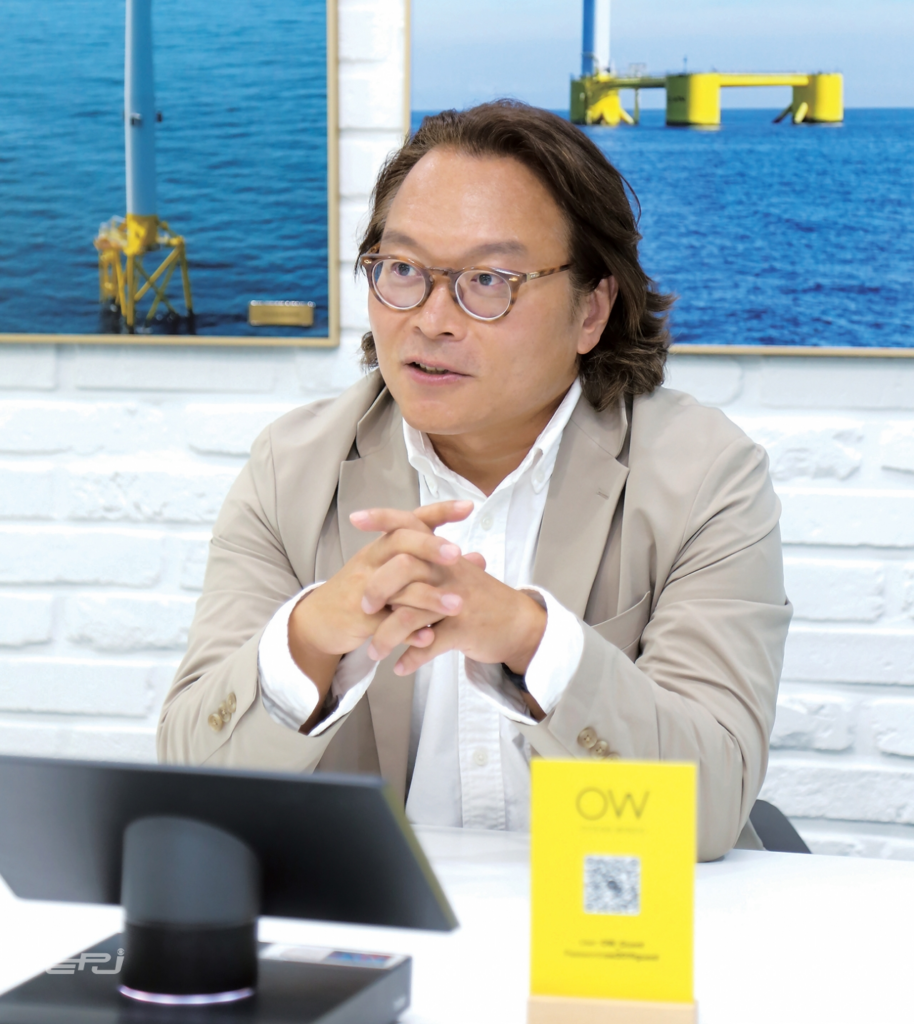
• Advancing the 1,125MW Hanbando Offshore Wind 1–3
• Driving Cost Efficiency Through Integrated Development, Finance, Construction, and Operations
[Interview – Alex Sungwoo Choi, Project Director, Hanbando Offshore Wind at Ocean Winds]
[By Yoonseok Park, Electric Power Journal]
As the urgency for global collaboration in addressing the climate crisis intensifies, Ocean Winds (OW), the Spain-based offshore wind developer accelerating the global energy transition through offshore wind, is spearheading a project to establish a large-scale offshore wind complex of over 1GW off the coast of Incheon.
In March, Ocean Winds secured EBL for three projects: Hanbando Offshore Wind 1 (420MW), Hanbando Offshore Wind 2 (375MW), and Hanbando Offshore Wind 3 (330MW). This achievement came just three years after the installation of three floating LiDARs in Korea’s Exclusive Economic Zone (EEZ), more than 100km from Incheon New Port, in early 2022. Project development will now be led by Hanbando Offshore Wind, a dedicated entity established for this purpose.
With a total planned capacity of 1,125MW, the projects represent the first to obtain licenses under Korea’s revised Detailed Licensing Criteria for EBL (August 2023), which imposed more stringent requirements on financial soundness.
“The revised criteria significantly strengthened the financial due diligence process, which prolonged the licensing procedure,” explained Alex Sungwoo Choi, Project Director of Hanbando Offshore Wind.
“Nonetheless, Hanbando Offshore Wind 1–3 became the first projects approved under the new framework, attracting strong attention across the industry. We are now advancing the Environmental Impact Assessment (EIA) and considering the establishment of local consultation committees to engage stakeholders, including fisheries, residents, and municipalities.”
Proactive Preparation to Accelerate Development
During the licensing process, Hanbando Offshore Wind finalized its contract with Sekwang Engineering Consultants, a specialist in marine environment and port studies, for the execution of the EIA.
Ocean Winds sees Hanbando Offshore Wind as integral to Korea’s RE100 commitments, NDC targets, and national decarbonization goals, while also helping Incheon diversify its energy mix, which remains heavily reliant on thermal generation despite its high energy independence.
He emphasized: “We signed the EIA contract as early as February, underscoring our determination to advance development with foresight. Since last year, we have also prepared essential prerequisites such as the MIA, MTSE, and TSA with KEPCO. These proactive steps ensure project momentum.”
He acknowledged that initial concerns were raised regarding national security impacts:“There were apprehensions about potential defense-related issues. However, given the project’s distance of over 100km offshore, we believe these can be constructively addressed through consultation and consensus.”
Building Local Acceptance Through Tailored Engagement
Electricity generated will be transmitted from the offshore substations to landing points in Incheon, with approximately 7–14km of underground cabling planned. This places fisheries, island residents, and shoreline communities at the forefront of stakeholder considerations.
He stated: “Stakeholder demands differ across groups, whether fisheries, island residents, or shoreline communities. Standard compensation and participation schemes alone cannot address these nuances. Tailored, ongoing consultation is essential to building trust and acceptance.”
He added that efforts will extend beyond affected fisheries to include residents of Deokjeok, Jawol, Yeongheung, and Songdo, with a focus on community cooperation, locally tailored support programs, and transparent dialogue.
Recognizing the limited direct linkage between Incheon’s manufacturing base and offshore wind, Hanbando Offshore Wind is exploring how Incheon’s port infrastructure and capital region proximity can be leveraged for economic activation.
“While many municipalities focus on securing construction ports, the greater long-term value lies in establishing O&M bases, which will operate for over 20 years,” Choi noted.
“We plan to deploy Crew Transfer Vessels (CTVs) and Service Operation Vessels (SOVs) from such a hub, creating local opportunities for skilled personnel and service providers.”
He also highlighted the fiscal benefits: “Tax revenue from project operations will contribute as much as, if not more than, existing fishing activities. Given Songdo’s accessibility, securing highly qualified personnel during the operational phase will also be feasible.”
Global Track Record: 19GW Across 17 Projects
Ocean Winds, a joint venture of EDP Renewables (EDPR) and ENGIE, currently develops and operates 17 offshore wind projects totaling 19GW across eight countries, including the UK, France, Portugal, Germany, the US, Australia, Poland, and Korea.
Its operational portfolio includes:
- Moray East (950MW, UK)
- SeaMade (487MW, Belgium)
- Windfloat Atlantic (25MW, Portugal) – the world’s first semi-submersible floating wind farm
Together, these projects account for 1.5GW of capacity—more than four times Korea’s current operating offshore wind base.
Under construction are:
- Dieppe Le Tréport (500MW, France)
- Îles d’Yeu and Noirmoutier (500MW, France)
- Moray West (882MW, UK)
- Éoliennes Flottantes du Golfe du Lion (EFGL, 30MW, France)
Ocean Winds’ end-to-end capabilities—covering development, financing, construction, and operations—combined with its global supply chain network deliver cost-efficient projects, reduce risks, and minimize delays.
Choi explained: “Unlike developers who focus solely on investment or early-stage development, Ocean Winds has the expertise to manage projects from inception through long-term operations and O&M. This not only enhances reliability but also allows us to optimize operating costs (OPEX) and reduce LCOE.”
“Our experience in turbine maintenance and long-term asset management will be directly applied to Hanbando Offshore Wind. In the mid- to long-term, we also hope to establish a training center in Songdo to cultivate offshore wind specialists.”
This aligns with Korea’s policy direction to drive LCOE reductions and sustainable offshore wind growth.
Strengthening Korea’s Industrial Ecosystem
Despite global cost pressures and financial headwinds slowing offshore wind deployment, Ocean Winds remains steadfast in Korea.
“While some developers are hesitant due to external conditions, Korea’s renewable energy policy and market fundamentals remain stable. There is no barrier to continuing development,” Choi emphasized.
“Through Hanbando Offshore Wind, we aim to usher in the offshore wind era in Incheon while contributing to sustainable growth for both the local community and the national economy.”
He concluded: “Korea already possesses world-class expertise in shipbuilding, construction, and heavy industries. By partnering with domestic supply chain companies, we will enhance project reliability while fostering ecosystem stability. Our commitment is to deliver the project on schedule, in full compliance with regulatory processes, and with the highest standards of excellence.”